

Understanding what kind of data do AI assessments measure can transform how you approach leadership development. Whether you’re a student exploring career options, a manager building your skills, or an executive developing future leaders, AI-powered assessments offer insights that traditional methods simply can’t match. These tools analyze everything from how you communicate to how you solve problems, creating a complete picture of your leadership style and potential.
AI assessments have become increasingly sophisticated. The global AI market reached $638.23 billion in 2024 and continues to grow rapidly, with leadership assessment tools becoming more accessible and accurate. Instead of relying solely on self-reported answers, modern AI platforms analyze real behaviors, conversations, and decision patterns to provide objective insights you can actually use.
This guide explains exactly what data AI assessments collect, how they analyze it, and what it means for your leadership journey. You’ll learn about the specific types of information these tools measure and how to use that knowledge to grow as a leader.
What Are the Core Data Types AI Assessments Measure?
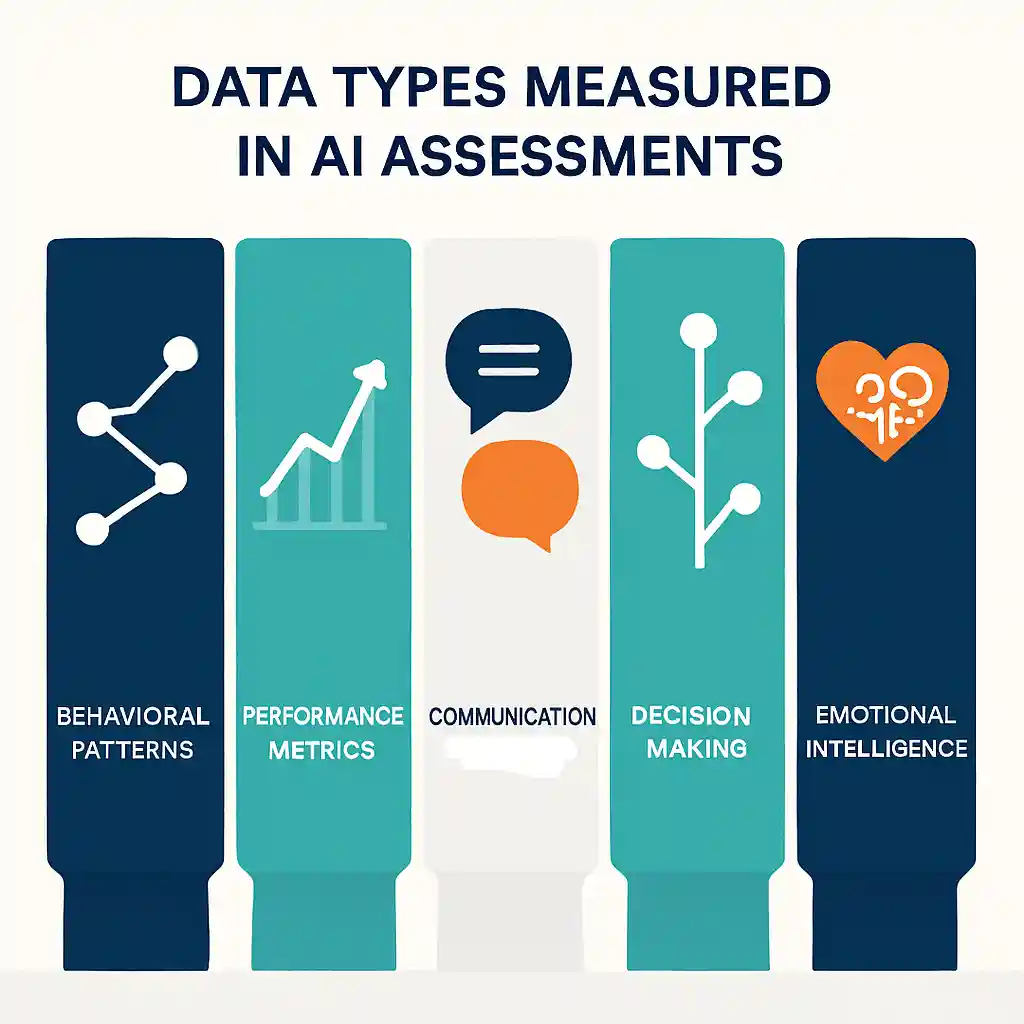
AI assessments measure several distinct categories of data that work together to create a complete leadership profile. Understanding these categories helps you see the full picture of what these tools actually do.
The first category is behavioral data. This includes observable actions, habits, and patterns in how you work and interact with others. For example, when you’re leading a group project in college, behavioral data might capture how often you check in with team members, whether you tend to delegate tasks or do them yourself, and how you respond when plans change unexpectedly.
Performance metrics form the second major category. These are measurable outcomes that show how effectively you complete tasks and achieve goals. Think of metrics like project completion rates, quality scores, or how quickly you learn new skills. A first-time manager might have performance data showing how their team’s productivity changed after they took on the role.
Communication patterns make up the third category. AI tools analyze how you express ideas, listen to others, and adjust your communication style for different situations. This could include the words you choose, how clearly you explain complex concepts, or whether you ask questions to ensure understanding.
Decision-making data captures the fourth category. This shows how you approach choices, weigh options, and commit to solutions. For a student leader deciding between two fundraising strategies, decision-making data might reveal whether you rely more on gut instinct or detailed analysis.
The final core category is emotional and interpersonal data. This measures emotional intelligence, empathy, self-awareness, and how you build relationships. These soft skills often determine whether a technically skilled leader truly succeeds in inspiring and developing others.
How AI Measures Behavioral and Personality Data
Behavioral and personality data form the foundation of most leadership assessments. Research shows AI can detect personality traits with up to 82% accuracy by analyzing patterns that humans might miss.
AI systems collect behavioral data through multiple channels. They might analyze video recordings of your presentations, review written communications like emails or reports, or track patterns in how you complete tasks over time. For instance, if you’re an intern managing a social media account, an AI tool might notice whether you consistently post at optimal times, respond quickly to comments, or adjust strategies based on engagement data.
Personality traits that AI commonly measures include the Big Five dimensions: openness, conscientiousness, extraversion, agreeableness, and emotional stability. Platforms like RuleYourMind use AI to evaluate these traits alongside leadership-specific qualities like adaptability, influence, and strategic thinking. The assessment happens naturally through your responses and behaviors rather than obvious multiple-choice questions.
What makes AI behavioral analysis powerful is its ability to spot patterns over time. A traditional personality test gives you a snapshot based on how you answer questions in one sitting. AI assessment tracks consistent patterns across different situations. If you claim to be highly organized but your work patterns show missed deadlines and last-minute scrambles, the AI recognizes that discrepancy.
The technology also identifies behavioral indicators that predict leadership success. These might include how you handle setbacks, whether you seek feedback proactively, or how you balance confidence with humility. For a team lead at work, this could mean the AI notices you always acknowledge mistakes quickly and use them as learning opportunities—a strong indicator of mature leadership.
Performance and Skills Assessment Data
Performance data provides concrete evidence of your capabilities in action. Unlike personality traits that describe your tendencies, performance metrics show what you actually accomplish and how well you do it.
AI systems measure technical skills through direct assessment. If you’re learning to code, the AI might evaluate not just whether your code works but also how efficiently you write it, whether you follow best practices, and how quickly you debug errors. The same principle applies to leadership skills—the AI can assess how effectively you run meetings, develop team members, or manage resources.
Efficiency metrics reveal how you use time and resources. A student managing a club budget might have AI analyze whether they research vendors thoroughly, negotiate effectively, and track spending accurately. For managers, efficiency data might show how they prioritize tasks, eliminate bottlenecks, or streamline processes for their teams.
Quality indicators measure the standard of your work output. This includes factors like attention to detail, thoroughness, and ability to meet or exceed requirements. An executive’s quality metrics might encompass the clarity of their strategic plans, the feasibility of their proposals, or how well they anticipate potential challenges.
Learning velocity represents another crucial performance dimension. AI tracks how quickly you acquire new skills and adapt to changing requirements. If you’re a new manager learning to give performance reviews, the AI might measure how your feedback quality improves over successive reviews and how quickly you implement coaching from your own manager.
Growth trajectory data shows your development over time. This is particularly valuable for identifying high-potential leaders. Leadership assessments that track growth can predict future success better than single-point-in-time evaluations because they show your capacity for continuous improvement.
What Kind of Data Do AI Assessments Measure in Communication?
Communication data reveals how effectively you share ideas, listen to others, and build understanding. This category has become increasingly important as 78% of organizations now use AI in at least one business function, making clear communication about technology and change essential for leaders.
Linguistic patterns form a key component of communication data. AI analyzes your word choice, sentence structure, and vocabulary level. For example, when explaining a complex project to team members, do you use technical jargon or translate concepts into accessible language? A good leader adjusts their communication style based on their audience, and AI can identify whether you do this naturally.
Clarity and conciseness metrics measure how efficiently you convey information. AI might analyze whether your emails get to the point quickly, if your presentations have clear takeaways, or whether your instructions leave room for confusion. A club president who writes clear, actionable meeting agendas demonstrates stronger communication skills than one whose messages require multiple follow-up questions.
Active listening indicators show how well you understand others. AI can detect this through response patterns—do you ask clarifying questions, acknowledge others’ points before adding your own, or build on ideas that teammates share? During a brainstorming session, a leader who actively listens will reference specific points others made and ask questions that show genuine engagement.
Influence and persuasion data captures your ability to inspire action and change minds. This doesn’t mean manipulation—it means presenting ideas effectively. AI might analyze how you structure arguments, use evidence, address concerns, and create emotional connection. For a manager proposing a new initiative, this data shows whether they can rally support from skeptical stakeholders.
Feedback quality represents another critical communication dimension. AI assesses how you give and receive feedback. Do you make feedback specific and actionable? Do you respond defensively to criticism or show openness to improvement? These patterns strongly predict leadership effectiveness.
Decision-Making and Problem-Solving Data
How you make decisions reveals your leadership approach more clearly than almost any other factor. AI assessments capture decision-making data by analyzing the process you follow, not just the outcomes you achieve.
Information gathering patterns show how thoroughly you research before deciding. Do you seek diverse perspectives, consult relevant data, and consider alternatives? Or do you rush to conclusions based on limited input? An intern deciding how to prioritize competing tasks demonstrates mature decision-making by asking questions, understanding consequences, and making informed choices.
Risk assessment ability indicates how well you evaluate potential upsides and downsides. AI tracks whether you’re too cautious, missing opportunities for calculated risks, or too aggressive, creating unnecessary exposure. A student organizing an event shows good risk assessment by having backup plans for key elements while not over-planning minor details.
Speed versus quality trade-offs reveal your decision-making style under pressure. Some situations require quick action with imperfect information. Others demand careful analysis. AI identifies whether you correctly gauge which approach each situation needs. A manager who can make rapid operational decisions but takes time for strategic choices demonstrates situational judgment.
Implementation planning shows whether your decisions translate into action. It’s one thing to choose a direction; it’s another to create a realistic plan for getting there. AI might evaluate whether you break big decisions into manageable steps, assign clear responsibilities, and set measurable milestones. These patterns distinguish leaders who get results from those whose decisions stall in the planning phase.
Platforms like RuleYourMind evaluate decision-making patterns across multiple scenarios to identify your natural approach. The assessment produces detailed insights comparable to expensive 360-style evaluations but at a fraction of the cost, making this level of analysis accessible to students and early-career professionals, not just executives.
Emotional Intelligence and Soft Skills Measurement
Emotional intelligence (EQ) often matters more than technical skills for leadership success. AI has become surprisingly effective at measuring these traditionally “soft” qualities through behavioral patterns and interaction analysis.
Self-awareness metrics indicate how well you understand your own strengths, weaknesses, emotions, and triggers. AI might identify self-awareness through patterns like seeking feedback regularly, acknowledging mistakes without defensiveness, or adjusting behavior based on past experiences. A team leader who recognizes they get impatient with slow progress and builds in extra time for complex projects demonstrates strong self-awareness.
Empathy indicators measure your ability to understand and respond to others’ feelings and perspectives. AI can detect empathy through communication patterns—do you acknowledge emotional context in conversations, consider how decisions affect others, or adjust your approach based on team members’ individual needs? During a difficult project, an empathetic leader notices when someone is struggling and offers support before being asked.
Emotional regulation shows how you manage your own emotions under stress. AI tracks patterns like response time to frustrating situations, tone shifts during difficult conversations, or recovery speed after setbacks. A manager who stays calm during a crisis, processes emotions privately, and models stability for their team demonstrates mature emotional regulation.
Relationship building data captures how you develop trust and connection with others. This includes consistency in follow-through, transparency in communication, and investment in others’ success. AI might measure whether you remember personal details about team members, celebrate their wins, or make time for relationship building beyond task-focused interactions.
Conflict navigation ability shows how you handle disagreements and tension. AI analyzes whether you avoid conflict, escalate unnecessarily, or find productive resolution paths. Strong leaders address issues directly while maintaining respect, seek win-win solutions, and prevent small problems from becoming major crises.
Understanding different leadership styles helps you interpret your emotional intelligence data. Some styles naturally lean toward empathy while others emphasize decisiveness. Neither is inherently better, but knowing your tendencies helps you develop complementary skills.
How AI Actually Processes Assessment Data
Understanding how AI processes the data it collects helps you trust and effectively use assessment results. The process involves several sophisticated steps that transform raw data into actionable insights.
Data collection happens through multiple methods. AI can analyze video, audio, speech transcripts, and social media information to assess personality, though privacy-focused platforms like RuleYourMind prioritize self-assessment tools that keep your data secure. The system might collect responses to scenario-based questions, track patterns in how you approach tasks, or analyze written communication samples.
Pattern recognition algorithms identify meaningful trends in your behavior. Machine learning models compare your data against vast databases of leadership patterns to spot correlations. For example, the AI might recognize that leaders who ask specific types of questions during meetings typically build more engaged teams. When it sees you asking similar questions, it connects that pattern to likely outcomes.
Natural language processing analyzes text and speech for deeper meaning. This technology goes beyond simple word counting to understand context, sentiment, and communication style. If you write “I think we should consider this option” versus “We should definitely pursue this option,” the AI recognizes the difference in confidence and decisiveness those phrases convey.
Comparative analysis benchmarks your results against relevant peer groups. Are you being evaluated as a student leader, first-time manager, or senior executive? The AI adjusts expectations based on experience level and context. A decisive communication style that works well for an experienced executive might be overconfident for an intern, and the AI accounts for these nuances.
Report generation transforms complex data into understandable insights. Rather than overwhelming you with raw numbers, AI systems create clear narratives about your strengths and development areas. Many platforms, including tools like Predictive Index, generate customized action plans based on your specific results, though neutral assessments should be combined with personal judgment about which recommendations to follow.
Continuous learning improves AI accuracy over time. As more people use these systems and as the AI tracks which leadership approaches lead to success, the algorithms become better at prediction and more nuanced in analysis. This means AI assessments keep getting more valuable as the technology matures.
Frequently Asked Questions
What is the difference between AI assessments and traditional personality tests?
Traditional personality tests rely on self-reported answers to direct questions, which can be gamed or skewed by social desirability bias. AI assessments analyze actual behaviors, communication patterns, and performance data across multiple situations. This makes them harder to manipulate and often more accurate. For example, instead of asking “Are you a good listener?” an AI tool might analyze whether you ask clarifying questions in conversations, acknowledge others’ points, and adjust based on feedback—all objective indicators of listening skills.
How accurate are AI leadership assessments compared to human evaluations?
AI assessments excel at identifying patterns and eliminating unconscious bias that affects human evaluators. Research shows AI can detect personality traits with up to 82% accuracy. However, the best approach combines AI insights with human judgment. AI provides objective data analysis, while human evaluators contribute context, intuition, and understanding of unique circumstances. Comprehensive leadership style assessments often integrate both approaches for the most reliable results.
Can AI assessments measure soft skills like empathy and creativity?
Yes, though differently than measuring technical skills. AI identifies empathy through communication patterns, response timing, and how you acknowledge others’ perspectives. Creativity assessment looks at idea generation, willingness to try novel approaches, and ability to connect seemingly unrelated concepts. While AI can’t directly measure internal feelings, it accurately measures behavioral manifestations of these qualities. For instance, an empathetic leader consistently considers impact on team members when making decisions—a pattern AI readily detects.
What kind of data do AI assessments measure that could invade privacy?
Privacy concerns are valid, which is why choosing ethical platforms matters. Responsible AI assessments should clearly explain what data they collect and how they use it. Privacy-focused tools collect only assessment-relevant information, encrypt data, and never sell personal information. Some platforms analyze public professional behavior, while others rely entirely on responses to assessment questions. Always review a platform’s privacy policy before participating. RuleYourMind, for example, prioritizes privacy-focused assessments that users control.
How long does it take for AI to gather enough data for accurate leadership assessment?
This varies by assessment type. Scenario-based assessments can provide valuable insights in 20-30 minutes by presenting diverse situations that reveal your approach to common leadership challenges. Ongoing behavioral analysis over weeks or months provides deeper insights by tracking patterns across real situations. Many platforms offer immediate preliminary results with increasing accuracy as they collect more data. The key is consistency—AI assessments work best when evaluating genuine patterns rather than one-time behaviors.
Are AI assessment results permanent, or do they change as I develop?
AI assessments capture your current state, not permanent traits. As you develop new skills, gain experience, and work on growth areas, your results will change. This is actually a strength—regular reassessment shows your progress and identifies new development opportunities. Many leaders take assessments annually or when moving into new roles. The data shows growth trajectories that help you and your organization make better development decisions. Think of AI assessments as periodic health checkups that inform ongoing improvement rather than permanent diagnoses.
Using AI Assessment Data for Leadership Growth
Now you understand what kind of data AI assessments measure and how they process it. The real value comes from using these insights to accelerate your leadership development.
Start by identifying your top three strengths and your top three development areas from your assessment results. Focus your energy where it matters most rather than trying to improve everything at once. If your results show strong decision-making but weaker communication, concentrate on communication development first since it likely affects your decision implementation.
Create specific, measurable actions based on your data. Generic goals like “improve leadership” won’t drive change. Instead, use concrete targets: “Ask two clarifying questions before making decisions” or “Provide specific, actionable feedback weekly to each team member.” AI assessment data gives you the specificity to create these focused development plans.
Track your progress over time. Many AI platforms offer follow-up assessments that show how you’ve grown. Even without formal reassessment, you can monitor whether you’re applying new behaviors consistently. Pay attention to feedback from colleagues, teammates, and managers—their observations validate whether your changes are working.
Whether you’re a student preparing for your first leadership role, a manager developing your skills, or an executive guiding your organization, AI assessments provide the data-driven insights that accelerate growth. Tools like RuleYourMind make comprehensive leadership assessment accessible on any device, giving you detailed reports and customized action plans that once cost thousands of dollars.
The future of leadership development is personal, data-driven, and accessible. Understanding what AI assessments measure and how to use that information puts you ahead of most leaders. Start by taking a quality assessment, commit to acting on your insights, and watch how targeted development based on objective data transforms your leadership impact.