

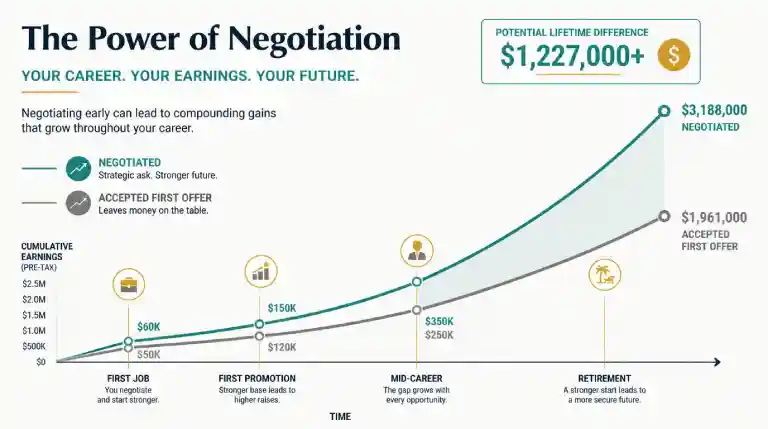
Knowing how to negotiate salary is one of the most valuable career skills you can develop — and one of the most avoided. A 2025 Resume Genius survey of 1,000 full-time U.S. workers found that 55% of people simply accept the first salary they are offered without pushing back at all (Yahoo Finance). That silence adds up fast. Research suggests that skipping a single salary negotiation at the start of your career can cost between $1 million and $1.5 million in lost lifetime earnings (GOBankingRates).
Whether you are a graduating student fielding your first job offer, a professional preparing for a promotion conversation, or an executive moving into a bigger role, this guide gives you a clear, practical framework for negotiating your pay. No bluffing. No gimmicks. Just strategies grounded in data and real-world experience.
Why Should You Negotiate Your Salary?
The simplest reason to negotiate is that it works. Among workers who do negotiate, 78% receive a better offer than the one they started with (Yahoo Finance). The average increase for people who negotiate is around 18.83% above the original offer, with some securing raises as high as 100% (The Interview Guys).
Yet fear holds most people back. Many worry that asking for more will make them look greedy or cause the employer to pull the offer entirely. The data says otherwise — 94% of negotiated offers remain intact (Procurement Tactics). Employers expect negotiation. In many cases, the first offer is deliberately set below the budget to leave room for it.
The financial impact compounds over time. A ZipRecruiter analysis found that negotiating a starting salary from $40,000 to $45,000 translates into more than $750,000 in additional lifetime earnings over a 45-year career (TopResume). Every raise, bonus, and retirement contribution built on that higher base amplifies the difference year after year.
How to Prepare Before You Negotiate Salary
Preparation is where salary negotiations are won or lost. Walking in without data is like taking an exam without studying — you might get lucky, but the odds are against you.
Research your market value. Use salary databases like Glassdoor, PayScale, and the Bureau of Labor Statistics to understand what people in your role, industry, and location typically earn. According to Glassdoor, the average employee could be earning as much as 13% more than their current salary (TopResume). That gap represents your opportunity.
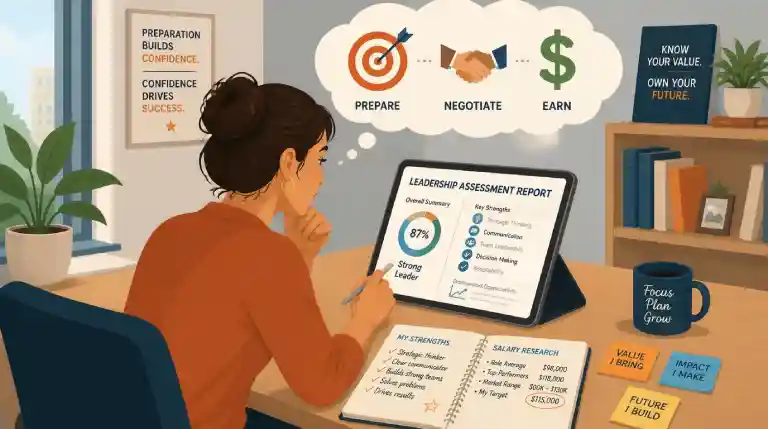
Know your own strengths. Before any negotiation, take stock of what makes you valuable. What results have you delivered? What problems have you solved? What skills do you bring that are hard to replace? A thorough leadership assessment can help you articulate your strengths with clarity and confidence — which is exactly what you need when sitting across from a hiring manager.
Define your range. Set three numbers: your ideal salary, a realistic target, and the lowest you would accept. Having a clear walk-away point prevents you from agreeing to something you will regret later. Anchor your ask on the higher end of the market range, not the lower end. Studies consistently show that the person who proposes a number first tends to set the frame for the entire conversation.
When Is the Right Time to Negotiate Salary?
Timing matters more than most people realize. Here are the situations where negotiation is most effective:
After receiving a job offer. This is the highest-leverage moment. The company has decided they want you, which means you have real bargaining power. Do not bring up salary during the first interview — let them fall in love with your skills first. Once you have the offer in writing, that is your window.
During a performance review. If you have a track record of strong results, a scheduled review is a natural time to ask for a raise. Come prepared with specific accomplishments and data. “I led the project that brought in $200,000 in new revenue” is far more persuasive than “I think I deserve more.”
After a major achievement. Did you just land a big client, ship a critical product, or solve a problem that saved the company money? Strike while the value is fresh. Your manager is most receptive when your contribution is visible and recent.
When your role has expanded. If your responsibilities have grown significantly since your last salary adjustment, you are doing a bigger job for the same pay. That mismatch is a strong case for renegotiation. Document the additional scope and present it clearly.
How to Negotiate Salary: A Step-by-Step Approach
Here is a practical framework you can follow regardless of your experience level:
Step 1: Express enthusiasm first. Start by thanking the employer for the offer and expressing genuine interest in the role. This sets a collaborative tone. Something like: “I’m really excited about this position and the team. I’d love to discuss the compensation package before I finalize.”
Step 2: Present your case with evidence. Share your market research and highlight the specific value you bring. Mention comparable salary data. Quantify your achievements whenever possible — numbers are harder to argue with than feelings.
Step 3: Name a specific number. Vague requests produce vague results. Instead of saying “I was hoping for a bit more,” say “Based on my research and the value I bring, I’d like to discuss a salary of $85,000.” Research confirms that people who propose a clear number tend to get better outcomes (Comerica).
Step 4: Listen and stay flexible. Negotiation is a two-way conversation, not a demand. If the employer cannot meet your salary number, ask about other elements of the compensation package — signing bonuses, remote work flexibility, professional development budgets, or equity. Signing incentive offers jumped from 20% to 42% between Q1 and Q2 of 2025, so employers are increasingly open to creative solutions when base salary budgets are tight (Procurement Tactics).
Step 5: Get it in writing. Once you reach an agreement, ask for the final offer in writing before you accept. Verbal promises can be forgotten or misunderstood. A written offer protects both sides.
Common Salary Negotiation Mistakes to Avoid
Accepting immediately out of relief. Getting a job offer feels great, and the instinct is to say yes right away. Resist it. It is perfectly normal — and expected — to ask for a day or two to review. Hiring managers will not think less of you for being thoughtful.
Negotiating without data. “I need more money” is not a negotiation strategy. “Based on industry benchmarks and my track record, $X reflects fair market value for this role” is. Always ground your ask in research, not emotion.
Focusing only on base salary. Compensation is more than just the number on your paycheck. Benefits, bonuses, stock options, flexible scheduling, and professional development stipends all have real value. Sometimes a company that cannot budge on salary can be generous in other areas.
Not knowing your worth. Many people undersell themselves because they have never done the work to understand their leadership strengths, career trajectory, or market position. Tools like RuleYourMind’s AI-powered leadership assessments can help here. The platform offers privacy-focused self-assessments that produce detailed reports — including career-fit insights and negotiation tactics — giving you concrete language to use in salary conversations.
Apologizing for asking. You are not being rude by negotiating. You are advocating for yourself. Drop phrases like “I’m sorry to ask” or “I don’t want to be difficult.” Replace them with confident, straightforward language.
How Pay Transparency Laws Are Changing Salary Negotiation
The salary negotiation landscape is shifting fast, and pay transparency laws are a major reason why. As of 2026, 18 U.S. states plus Washington, D.C. have enacted laws requiring employers to disclose salary ranges in job postings or during the hiring process (Rippling). The percentage of U.S. job postings that include salary information has more than tripled since 2020, rising from 18.4% to 57.8% by late 2024 (Recruitmentzilla).
This is good news for anyone learning how to negotiate salary. When you can see the range before you even apply, you have an anchor for your ask. You know the floor and the ceiling. Your job becomes positioning yourself toward the top of that range with evidence of the value you bring.
Pay transparency also helps close wage gaps. According to Payscale’s 2026 Gender Pay Gap Report, states with transparency laws have made measurable progress in narrowing the controlled gender pay gap (Recruitmentzilla). When pay ranges are public, it is harder for systemic biases to go unnoticed.
If you are job hunting, prioritize listings that include salary information. If a posting does not include it, many states now allow you to ask — and employers are required to provide it. Use that information to negotiate from a position of knowledge, not guesswork.
How to Negotiate Beyond Base Salary
Sometimes the best negotiation wins are not about the number on your paycheck. Here are areas worth discussing:
Professional development. Ask for a budget for courses, certifications, or conferences. Employers who invest in leadership assessment and development see strong returns — and you benefit from the skills. This is an easy win for both sides because it costs the employer less than a salary bump but can accelerate your career significantly.
Signing bonus. If the company cannot move on base salary due to internal pay bands, a one-time signing bonus can bridge the gap. These have become increasingly common, so do not be afraid to ask.
Remote or hybrid flexibility. A 2024 study found that three-quarters of workers feel more relaxed discussing salary on video calls than in face-to-face meetings (Procurement Tactics). If remote work matters to you, negotiate it as part of your package. It has real financial value in saved commuting costs and time.
Title and scope. A higher title can set you up for a better salary at your next job. If the company cannot pay more now, a title adjustment — from “coordinator” to “manager” or “specialist” to “lead” — might be worth exploring.
Performance review timeline. If the employer cannot offer the salary you want today, negotiate an accelerated review in three or six months. Get the conditions for a raise documented so you have a clear path forward. Understanding what leadership competencies your organization values can help you target the right milestones — frameworks like the Korn Ferry leadership assessment model can give you insight into what employers look for when evaluating leadership potential.
Frequently Asked Questions About How to Negotiate Salary
Is it OK to negotiate salary for your first job?
Absolutely. In fact, your first salary sets the baseline for every raise, bonus, and job offer that follows. Even a modest increase of $5,000 can compound into hundreds of thousands of dollars over a career. You do not need years of experience to negotiate — you just need research, a clear number, and the willingness to ask.
What percentage should I ask for when negotiating salary?
There is no universal rule, but asking for 10–20% above the initial offer is a common and reasonable starting point. The key is grounding your number in market data, not just picking an arbitrary percentage. Research shows that successful negotiators gain an average of about 18.83% over the original offer (The Interview Guys).
Can negotiating salary cost you the job offer?
It is extremely rare. Data shows that 94% of negotiated offers remain intact (Procurement Tactics). Employers expect some level of negotiation, especially for professional and managerial roles. The risk of losing an offer is far smaller than the cost of not asking.
Do men and women negotiate salary differently?
The data has evolved significantly. Research from UC Berkeley found that professional women now report negotiating their salaries more often than men — but they also report being turned down more frequently (UC Berkeley Haas). The issue is not whether women ask, but how the ask is received. Framing negotiation as a collaborative conversation — rather than a demand — can help all negotiators, regardless of gender.
How do I negotiate salary over email vs. in person?
Both work. Email gives you time to craft your words carefully, which is helpful if you are nervous. In-person or video conversations let you read body language and build rapport. A strong approach is to start the conversation in person or on a call, then follow up with a written summary of what was discussed and agreed upon.
What if the employer says the salary is non-negotiable?
First, verify whether they mean the base salary specifically or the entire compensation package. Even when base salary is locked, there is often flexibility on bonuses, benefits, start date, professional development budgets, or review timelines. Ask: “I understand the base salary is fixed — is there flexibility in other parts of the package?” You may be surprised by what opens up.
Conclusion
Learning how to negotiate salary is not about being aggressive or confrontational. It is about preparation, clarity, and the confidence to ask for what the data says you are worth. The numbers are overwhelmingly in your favor: most people who negotiate receive a better offer, and almost no one loses an offer for trying.
The hardest part is getting started. If you are unsure where you stand or how to articulate your value, a structured self-assessment can give you the clarity you need. RuleYourMind offers AI-powered leadership assessments that include career-fit insights and negotiation tactics — all accessible on any device, with full privacy. It is a practical first step for anyone who wants to walk into their next salary conversation prepared and confident.
Your skills have value. Make sure your salary reflects it.